
Inside Dicolor’s Third-Generation DCD Energy-Saving Technology
Recommended reading
Why LED Push Force Matters for Rental LED Displays
Recommended reading+86 755-33691736inquiry@dicolorled.comNo.13 Huiye Road ,Tangjia Community,Fenghuang Street, Guangming District, Shenzhen,China 518103 Shenzhen Dicolor Intelligent Technology(Dongguang) Co., Ltd Gate No.4-5, Building A-17,...
Beyond the Stadium: How LED Displays Create Modern Football Experiences
Recommended reading+86 755-33691736inquiry@dicolorled.comNo.13 Huiye Road ,Tangjia Community,Fenghuang Street, Guangming District, Shenzhen,China 518103 Shenzhen Dicolor Intelligent Technology(Dongguang) Co., Ltd Gate No.4-5, Building A-17,...
Why Top Concerts Are Switching to Black Rental LED Screens
Recommended reading+86 755-33691736inquiry@dicolorled.comNo.13 Huiye Road ,Tangjia Community,Fenghuang Street, Guangming District, Shenzhen,China 518103 Shenzhen Dicolor Intelligent Technology(Dongguang) Co., Ltd Gate No.4-5, Building A-17,...
Why “Thrust Force” Determines Your Screen’s Lifespan
Recommended reading+86 755-33691736inquiry@dicolorled.comNo.13 Huiye Road ,Tangjia Community,Fenghuang Street, Guangming District, Shenzhen,China 518103 Shenzhen Dicolor Intelligent Technology(Dongguang) Co., Ltd Gate No.4-5, Building A-17,...
Customer Service
+86 755-33691736
inquiry@dicolorled.com
Headquarters Address
No.13 Huiye Road ,Tangjia Community,Fenghuang Street, Guangming District, Shenzhen,China 518103
Shenzhen Dicolor Intelligent Technology(Dongguang) Co., Ltd Gate No.4-5, Building A-17, No.780 Xiecao Road , Xiegang Town, Dongguan, Guangdong, China
As LED displays become larger and more widely used in live events, commercial spaces, and fixed installations, energy efficiency is no longer just an operating-cost consideration. It also affects electrical design, heat management, image consistency, and long-term reliability.
Dicolor’s third-generation DCD energy-saving technology focuses on a fundamental question: can an LED display use electrical power more precisely without compromising the visual experience? Its approach begins with how voltage is supplied to red, green, and blue LEDs.
I. Why Does LED Power Delivery Matter?
An LED display converts electrical energy into light, but not all supplied energy becomes visible output. Electrical losses generate heat, adding to the thermal load of LED modules, power supplies, and other components.
For large display systems, the consequences can extend beyond electricity bills. Higher power demand may increase requirements for power distribution, while prolonged thermal stress can affect component aging and display consistency. Improving efficiency at the power-delivery stage is therefore one way to address several operational challenges together.
II. How Does Third-Generation DCD Technology Work?
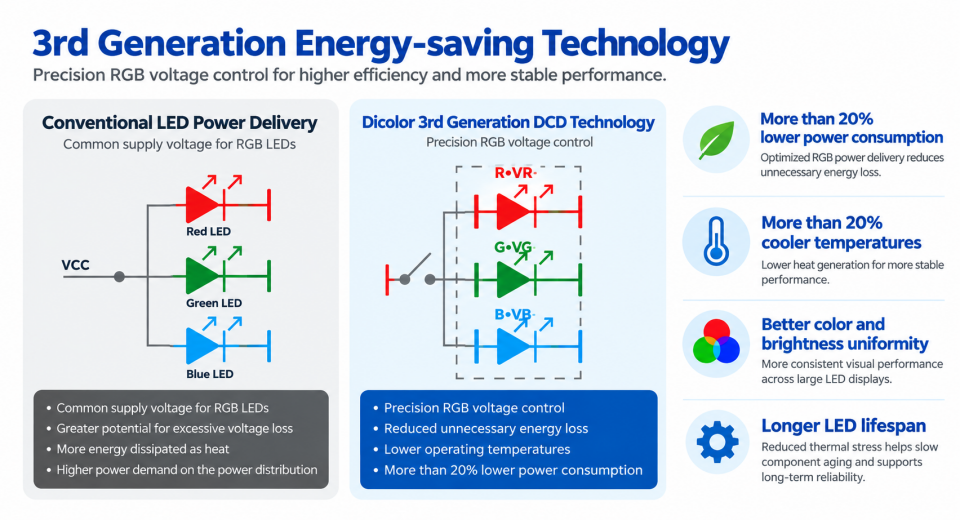
Red, green, and blue LEDs have different electrical characteristics. In conventional common-anode architectures using a shared supply voltage, that voltage may be higher than an individual LED color requires. The difference can be dissipated as heat in the driving circuitry.
DCD technology uses differentiated RGB supply voltages to better match the electrical requirements of each color channel. By reducing unnecessary voltage-related losses, the system can improve energy utilization while supporting the intended display output.
In simple terms, the goal is to supply each color channel more appropriately rather than waste excess electrical energy as heat.
III. What Benefits Can More Precise Power Management Deliver?
Lower Power Consumption
Dicolor’s technical materials report more than 20% lower power consumption under specified comparison conditions at comparable brightness. For installations that operate over long periods or across repeated events, lower electrical demand can translate into meaningful energy savings.
Reduced Heat and Thermal Stress
Lower electrical losses also mean less energy is dissipated as heat. This can ease the thermal burden on LED modules, power-supply assemblies, and electronic components, particularly during extended operation.
More Consistent Visual Performance
Temperature changes and uneven operating conditions can contribute to color and brightness variation. In demanding full-white scenes, such variation may appear as an unwanted cyan tint or uneven image uniformity.
Potential Long-Term Reliability Benefits
Reducing heat-related stress may help slow the aging of LEDs and surrounding electronic components. It can also lessen thermal demands on power-supply assemblies.
IV. What Does Energy Efficiency Mean in Real Projects?
The value of energy-saving technology becomes clearer when it is considered across the full operating cycle of a display. For rental and touring applications, reduced power demand may simplify the planning of electrical infrastructure and reduce operating costs. For fixed installations, energy consumption and thermal management can influence long-term operating expenditure and service requirements.
Any reduction in cable quantity, conductor size, or power-distribution capacity must be evaluated by qualified engineers using project-specific calculations and applicable safety standards. Lower display power consumption does not automatically justify changes to electrical protection or cabling.
An Illustrative Energy-Savings Calculation
Suppose a display system operates at an average of 20kW, and an alternative configuration reduces that average by 20% under the same operating conditions. The difference would be 4kW. Over 1,000 hours, the estimated energy saved would be 4,000 kWh. At an illustrative electricity rate of $0.15 per kWh, that equals $600 in electricity savings.
Energy saved (kWh) = power reduction (kW) × operating hours (h).
V. DCD Technology in Action: Dicolor UL Series
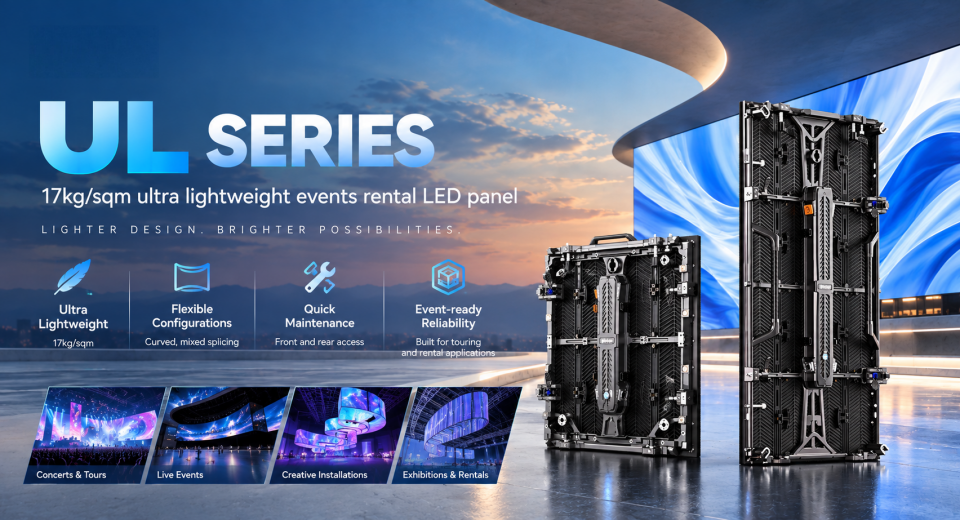
Dicolor UL Series provides one example of how energy-saving technology can be integrated into a rental LED solution. Alongside third-generation DCD technology, UL series combines a lightweight design of approximately 17 kg/m² with flexible configurations, including curved installations, and front and rear maintenance.
For concerts, festivals, and touring productions, these features address complementary needs: efficient power use during operation, manageable handling and rigging, adaptable stage layouts, and convenient servicing between events. UL panel is an application example of DCD technology—not the sole focus of the technology itself.
VI. Frequently Asked Questions
Does energy-saving technology necessarily reduce brightness?
No. DCD technology is intended to reduce avoidable electrical losses through more precise voltage delivery. Performance comparisons should still use equivalent brightness and operating conditions.
Does lower power consumption guarantee a longer LED lifespan?
No fixed lifespan increase can be guaranteed. Reduced heat-related stress may support component longevity, but actual service life depends on the product, environment, operating hours, and maintenance.
How should buyers compare energy-efficient LED displays?
Review power figures under comparable brightness and content conditions, ask for the test methodology, and consider total cost of ownership—including electricity, electrical infrastructure, maintenance, and operating hours.
Conclusion: Energy Efficiency Starts with Smarter Engineering
Effective LED energy saving is not simply about lowering a specification-sheet number. It begins with reducing avoidable electrical losses and considering the consequences for heat, visual consistency, and long-term operation.
Through differentiated RGB voltage supply, Dicolor’s third-generation DCD technology offers a more precise approach to LED power management. As display projects grow in scale and complexity, engineering efficiency into the system can create practical value across a wide range of applications.
Dicolor is a global provider of LED displays. We show premium technology with cutting-edge technology and advanced innovations, providing LED display products, solutions,and services worldwide for rental stage events, ads billboards, commercial display, etc.